











Asamushi, Chumushi, Fukamushi: How Steaming Creates Three Different Japanese Teas
Imagine this situation: you are standing in a store, and in front of you are two packages with the concise label “sencha”. However, one is priced at 300 hryvnias, while the other is a full 900. In the more expensive package, the leaf looks brittle, dark, and with some strange “dust” at the bottom, while the cheaper counterpart pleases the eye with even, golden needles. Why does this happen, and where is the logic? The answer to this complex question hides in a single Japanese word-mushi, which translates as steaming. It is this primary technological operation in the production of Japanese green tea, or rather the duration of this process, that creates three fundamentally different sounding styles of sencha: asamushi, chumushi, and fukamushi.
Why Do the Japanese Steam Fresh Tea Leaves?
To understand the essence of the process, it is worth delving into the biology of the plant. Immediately after harvesting, the tea leaf begins to inevitably oxidize: enzymes inside the cells attack the structure, turning the green color brown. If this natural process is not stopped at the very beginning, we will eventually get a classic black tea. Japanese masters produce green tea precisely by stopping oxidation with hot steam, the temperature of which reaches about 100 °C. The freshly harvested leaf is fed onto steam conveyors, where the steam instantly inactivates the oxidative enzymes, fixing the chlorophyll and flavor compounds in the state they were in at the moment of harvest. Only after this is the leaf rolled and dried. This is a unique Japanese technique, as the Chinese use hot metal in a wok rather than steam for the same purpose, which yields a completely different, more roasted and “fired” taste. Thanks to the steam, Japanese tea remains fresh, grassy, and “green to the very end.”
How Does Steaming Time Create Three Different Tea Styles?
We at TEAHOUSE often encounter situations where clients confuse these concepts, so let’s break it down in detail. The main variable in this technology is exactly how many seconds the leaf remains in the steam chamber, because a difference of just 20-30 seconds can create a fundamentally different flavor profile.
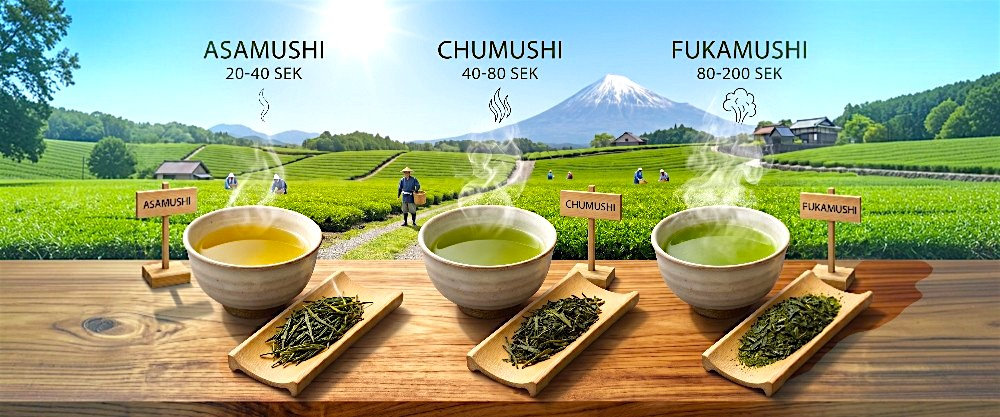
The first style is Asamushi, which means “light steaming,” lasting only 20-40 seconds. During this short time, the structure of the leaf remains intact, so the dry tea looks like beautiful whole needles. When brewed, the water delicately extracts only the surface substances, and the infusion turns out transparent and golden-green, with a fresh, light grassy taste and delicate astringency.
The next stage is Chumushi, or “medium steaming,” lasting 40-80 seconds. The leaf in such a tea is already partially brittle. This is the classic, highly balanced, and familiar sencha taste that many consider the “golden mean” across all indicators.
Finally, there is Fukamushi-“deep steaming,” which lasts from 80 to 200 seconds. The prolonged exposure to steam severely breaks down the cellular structure of the leaf, which is why the dry tea becomes very brittle and contains a lot of fine “powder.” Deep steaming penetrates the leaf thoroughly, softening the tissues, so when you brew it, you extract much more catechins, chlorophyll, and fine leaf particles. This results in the characteristic cloudiness, the thick, bright green color of the infusion, and a rich, velvety, sweet taste that is almost completely devoid of astringency.
Why Did the Fukamushi Style Emerge?
The history of fukamushi’s invention is extremely interesting because it is one of the few tea technologies whose origin can be dated to a specific decade. Deep steaming was born in the 1960s in Shizuoka Prefecture, and the reason for its appearance was purely market-driven. During the post-war period, export demand for Japanese tea dropped sharply, and Shizuoka producers desperately looked for ways to boost domestic consumption. They began experimenting with prolonged steaming and discovered that the mass Japanese consumer preferred the rich, mild taste with almost no bitterness far more than the classic, delicate asamushi. Thus, a new style was born, which today accounts for a significant share of all tea production in Japan.
How Did Terroir and Former Samurai Influence the Taste of Makinohara Tea?
The Makinohara plateau near Mount Fuji is one of the leading regions for fukamushi production, and there is a compelling landscape-related reason for this. Unlike mountain terraces where the tea bushes are shaded, the sun beats down in full force on the Makinohara plain, causing the leaves to grow thicker and with a more rigid cellular structure. With traditional short steaming, such leaves produced a tea with excessive, harsh astringency. Local masters, notably Totsuka Toyozo and Imamura Mohei, began purposefully prolonging the steaming time to tame this natural harshness. The result exceeded expectations: the problematic terroir gave birth to a new technology, making the tea soft, sweetish, and deeply colored. Incidentally, until the mid-19th century, Makinohara was a barren wasteland. It was transformed into productive plantations by the samurai of the Tokugawa clan, who, left without status after the modernization of Japan, developed these lands through grueling manual labor. We at TEAHOUSE treat such historical terroirs with immense respect, as behind every leaf lies the fate of real people.
How to Choose the Ideal Sencha Style for Your Mood?
It is important to understand that there is no concept of “better” or “worse” here-these are simply two different flavor worlds. Choose asamushi if you appreciate elegance, a clean fresh taste, a transparent infusion, and the sight of whole, needle-like leaves in your bowl; by its profile, this style is closer to Chinese green teas. Fukamushi, on the other hand, is perfect for those who love richness, a velvety texture, a thick color, and natural sweetness without bitterness. This tea is also ideal for beginners because it is more stable and “forgives” brewing mistakes. Relying on our own expertise, we at TEAHOUSE recommend trying both options so you can experience firsthand how a 30-second difference in the steam chamber can create two absolutely distinct tea styles from the exact same bush.
Frequently Asked Questions About Japanese Steaming
Is fukamushi of better quality than asamushi? No, they are simply different processing styles. Asamushi is valued for its refinement, while fukamushi is prized for its richness.
Why does the fukamushi infusion look cloudy? This is a defining feature of the style. During the prolonged steaming process, the leaf becomes brittle, and tiny particles pass into the infusion.
What is the best way to start exploring Japanese tea? Beginners are often advised to start with fukamushi, as its mild and rich taste is much easier to perceive and appreciate.