




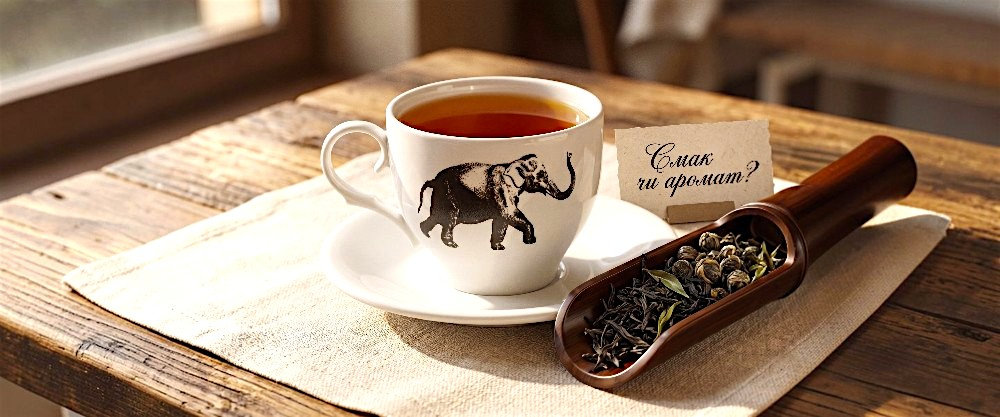
Taste or Aroma? How Smell Changes the Perception of Tea
Imagine that you are holding a transparent bowl of hot oolong, you take the first cautious sip, and suddenly you sense a distinct aftertaste of ripe peach, spring lilac, or even fresh butter. But how is this possible if, physically, in your cup there is only hot water and fermented leaves of the tea plant? Today, in our improvised lecture, we will break down this fascinating illusion of our brain. We will talk in detail about why our usual daily tasting is a much more complex physiological process than it seems at first glance. You will learn exactly how our own receptors deceive us every time we brew fresh tea, and we will learn to recognize the true reasons for such a multifaceted experience.
Why do we perceive notes of flowers and chocolate in tea?
We remember well from school biology lessons that our taste receptors, located on the surface of the tongue, are capable of distinguishing only a few basic indicators. This short list includes sweet, salty, sour, bitter, and the specific taste of protein food called umami. When you taste even the most elite and expensive tea, your tongue actually only reads light natural bitterness, a certain astringency, and, perhaps, a barely perceptible sweetness on the tip. All other complex gastronomic associations, such as hints of forest honey, dark caramel, berries, or freshly baked bread, are formed exclusively thanks to our refined sense of smell. It is the synergy of basic physical taste on the tongue and complex volatile aromatics in the nasal cavity that creates the multidimensional phenomenon that tasting specialists call the term “flavor.”
How does retronasal olfaction form our impression of the brew?
Most people mistakenly believe that we fully experience smells only when we inhale air deeply through the nose, leaning directly over the cup. However, the most important and interesting stage of tea tasting occurs precisely during the sip itself, thanks to so-called retronasal olfaction. When you swallow a warm infusion and automatically exhale air through the nose, tiny aromatic molecules rapidly rise from the oral cavity directly to your olfactory bulbs. At that moment, your brain instantly processes the received information and tightly “binds” the recognized aroma to the liquid in your mouth. Through such a clever biological mechanism, it seems to you that you are specifically “tasting” juicy raspberries or orchids, although in reality you are simply smelling them from inside your own body.
How do temperature and texture affect the “sound” of tea?
The physical properties of the finished infusion play an equally important role in how we ultimately perceive its aromatic profile. High water temperature most actively stimulates the evaporation of essential oils, so hot tea always seems significantly more intense, richer, and more voluminous to us. If you allow the same infusion to cool down strongly, its volatile compounds will become much less active, and only basic receptor sensations will come to the foreground, for example, noticeable bitterness or acidity.
The texture of the liquid, or its density, also significantly complements the overall picture of the tasting experience. A thick, slightly oily infusion creates a pleasant sensation of body, softly coating the receptors and significantly prolonging the overall aftertaste. TEAHOUSE company experts always advise using a cha hai—a special open vessel—when brewing complex blends, like our signature black tea Dnipro Breakfast. By pouring the infusion into the cha hai, you allow it to saturate a bit with oxygen and equalize the temperature. This immediately makes its malty, bready, and chocolate notes much more distinct, rounded, and comfortable for perception.
Why do our expectations change the real profile of the infusion?
The psychology of human perception is another powerful tool that subtly guides our subjective sensations during every tea drinking session. When you read a beautiful poetic description on the packaging where experts mention “refined hints of walnut, forest berries, and exotic spices,” your brain prepares in advance to search for precisely these markers. Visual cues, the degree of transparency of the liquid, its color, and even the shape of your favorite bowl create a certain context that strongly influences the final interpretation of the aroma. If a bright red tea is poured for you, you will subconsciously expect warm, sweet, or distinctly fruity notes from it. Your sensory system will dutifully analyze the liquid and try to confirm these guesses, even if the style of the brew differs somewhat.
How to correctly taste tea for maximum revelation?
To learn to recognize the finest and most hidden nuances, it is worth consciously transforming ordinary drinking into a full sensory experience. To start, try the professional technique of drawing the infusion into your mouth with a slight but loud slurp to enrich the liquid with oxygen. This instantly enhances the release of aromatic compounds and makes your retronasal response much more powerful and bright. Also, be sure to pay attention to the aroma that remains at the bottom of the empty bowl after you have finished your portion. Often, it is on the cooled walls of the ceramic ware that the most delicate, sweetest notes of flowers or honey concentrate, which during the hot stage were hidden behind the overall density of the brew.
If you want to immerse yourself even deeper into this fascinating exploration, try using a classic gaiwan instead of a standard European teapot. Its ceramic lid serves as an excellent tool for capturing and analyzing the smell: it is enough just to bring it to your nose immediately after pouring off the water. With each new steeping (prolyv), you will clearly notice how the initial style of the tea gradually evolves. You will feel how it changes its bright top notes to a deeper, more voluminous, and calm sound. This systematic approach will help you train your own “taste memory” and enjoy every new tea drinking session as a true gastronomic art.
Frequently Asked Questions
- Why does dry tea smell sweet, but the finished infusion tastes bitter? The aroma of the dry leaf is created by volatile essential oils that are easily perceived by our nose and form an expectation of sweetness. Bitterness, however, arises due to the excessive release of tannins and polyphenols during the leaf’s contact with water. If you over-steep the brew or use water that is too hot, the bitter physical taste will simply mask all the delicate aromatics.
- What water temperature best reveals the smells of elite tea? For most high-quality varieties, the optimal range is considered a temperature from 80 to 95 degrees Celsius. This water is hot enough to effectively release volatile essential oils, but at the same time, it does not scorch the delicate leaf. Water that is too cold will leave the aroma pale and inexpressive, not allowing it to reveal its depth.
- Is it possible to train your receptors for better recognition of notes? Yes, the sensory apparatus is perfectly trainable through regular conscious practice. Specialists advise smelling fresh fruits, flowers, tree bark, and various spices more often in daily life. This will significantly expand your internal library of aromas, allowing the brain to find the correct associations faster during tea drinking.