

The Most Common Shapes of Chinese Teacups: A Guide to Choosing Teaware

When we first begin to dive into the fascinating world of tea culture, our attention is usually entirely focused on choosing the tea leaf itself. We carefully study the varieties, pay attention to the region of origin and processing methods, trying to find our perfect flavor profile. However, over time comes the realization that the teaware we drink from plays an equally important role in shaping the overall tasting experience. Chinese masters have perfected the geometry of bowls for centuries, creating various shapes, each of which has a specific functional purpose and affects the unfolding of the tea infusion.
How does the shape of a teacup affect the unfolding of tea flavor?
At first glance, it might seem that the geometry of the teaware is responsible solely for aesthetics and tactile comfort when held in the hand. In reality, the shape of the walls, the width of the rim, and the angle of inclination directly control thermodynamics and exactly how the aroma reaches our receptors. Wide and open bowls promote rapid cooling of the infusion, while closed shapes retain heat inside much longer. Moreover, the correct curve of the rim can direct the tea flow to specific areas of the tongue, emphasizing the natural sweetness of the tea or, conversely, smoothing out excessive astringency.
What is the Douli bei (Dǒulì bēi) teacup and what is it suitable for?
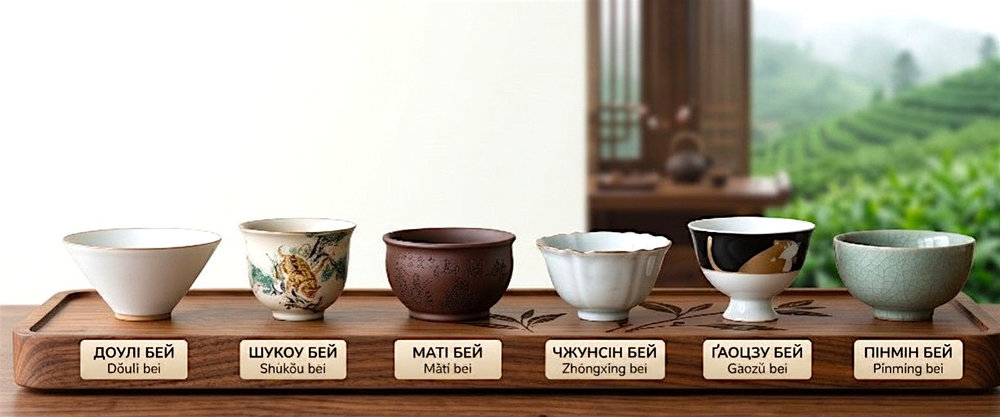
One of the most recognizable and classic shapes is called Douli bei, which literally translates as “bamboo hat.” Visually, it truly resembles the traditional conical headwear of Asian farmers: it has a very wide, open rim and a rather narrow base. Thanks to this design, the infusion cools down as quickly as possible, making it an ideal choice for tasting delicate green and white teas. The large surface area in contact with the air allows excess heat to dissipate instantly, so you won’t burn your lips, and the subtle spring aroma will unfold easily and very naturally.
What are the features of the Shukou bei (Shùkǒu bēi) teacup?
If your main goal is to enjoy a thick, multifaceted aroma, you should definitely pay attention to the Shukou bei shape. Its key feature lies in its slightly inward-curving edges, which create a kind of trap for volatile essential compounds during the tea drinking. This geometry works on the principle of a professional tasting glass, concentrating all the nuances of the scent directly near your nose. This shape flawlessly reveals the potential of Guangdong oolongs, Wuyi rock teas, and rich black teas, allowing you to catch the subtlest floral or honey notes even before the first sip.
Why is the Mati bei (Mǎtí bēi) shape often chosen for pu-erhs?
Another basic and incredibly practical configuration is called Mati bei, which translates as “horse hoof.” It has a wider and flatter base compared to conical shapes, and its straight walls create a very stable and comfortable structure. Thanks to such volume and geometry, the bowl perfectly accumulates heat, keeping the infusion hot for a long time. That is why it is most often used for long tea sessions with thick shou pu-erhs or aged dark teas, where it is critically important to maintain a high temperature to fully experience the thickness and buttery texture.
What is remarkable about the bell-shaped Zhongxing bei (Zhōngxíng bēi) teacup?
This shape visually resembles an inverted traditional Chinese bell. It has rather high, almost straight walls that smoothly but noticeably flare out right at the rim. This geometry is a kind of “golden ratio” in the tea world: it perfectly retains the temperature of the infusion inside, but at the same time allows it to cool slightly at the edges so as not to burn your lips during a sip. The curve of the rim fits the mouth very anatomically, so drinking tea from a Zhongxing bei is considered one of the most comfortable experiences. It is ideal for medium and heavily roasted oolongs, such as Da Hong Pao or Tie Guan Yin.
When should you use the Gaozu bei (Gāozǔ bēi) bowl?
Gaozu bei is a teacup on a pronounced, high stem, shaped like a miniature goblet or a European wine glass. This design has deep historical roots and looks extremely elegant and aristocratic during a ceremony. Besides aesthetic pleasure, the high stem also serves an important practical function: you hold the bowl exclusively by it, so your fingers do not come into contact with the hot zone where the infusion is. This is a great choice for brewing teas with high-temperature water (for example, aged white teas or shou pu-erhs), when a regular teacup might feel too hot.
Pinming bei (Pǐnmíng bēi): a classic for tasting
The name Pinming bei translates as “tea tasting bowl,” and it is the most frequent guest on tea boards (chaban) all over the world. It has the shape of a perfect hemisphere or a soft cylinder without sharp curves or angles. This is an absolutely universal, basic tool that doesn’t try to enhance any single characteristic of the tea (as narrow or wide shapes do) but instead presents the infusion as honestly and balanced as possible. If you want to understand the true, unembellished character of a new variety, taste it from a classic Pinming bei.
How to properly choose a Chinese teacup for your home collection?
Building your own teaware collection is a deeply individual process that depends on your favorite varieties and personal tactile preferences. At TEAHOUSE, we often advise our guests to start their acquaintance with classic, medium-volume universal shapes that fit comfortably in the palm and suit most types of tea. Later, as you begin to better distinguish the nuances of different steepings, your collection will naturally expand with specialized bowls for specific tasks. Also, be sure to pay attention to the thickness of the walls: thin porcelain is better suited for light and delicate varieties, while thick ceramics are perfectly created for dark and fermented ones.
FAQ: Frequently Asked Questions about choosing cups for the tea ceremony
- Can I drink different types of tea from the same teacup? Yes, you can absolutely use one favorite vessel for different varieties if it is made of glazed porcelain or glass, which do not absorb odors at all. However, it is better to dedicate unglazed porous clay teaware to one specific type of tea, as over time the walls accumulate essential oils and can affect the flavor profile of subsequent brews.
- What bowl volume is considered correct for a Chinese ceremony? The classic volume usually ranges from 25 to 60 milliliters, which is ideal for the traditional method of multiple steepings (Pin Cha). Such a small size allows you to drink the infusion in a few small sips before it cools down, and to fully experience the dynamic changes in taste from the first to the last brew.
- How to properly hold a teacup during a tea session? Traditional tea etiquette involves holding the bowl with three fingers: the thumb and index finger gently hold it by the top edge, and the middle finger slightly supports the bottom. This graceful gesture not only looks very elegant but also makes direct practical sense, as the top edge and the very bottom heat up the least, reliably protecting your fingers from burns.
Чи була ця стаття корисною?
Ще немає оцінок — будьте першими.