

GABA Tea: What It Is, How It’s Made, and How It Differs from Regular Tea

GABA tea has become one of the most talked-about categories in the world of Chinese tea. Oolong enthusiasts seek it out, newcomers to premium tea discover it through tea collections, and the term GABA appears more and more often in tea descriptions. At the same time, many myths surround it: some call it a “brain tea,” others believe it is a separate type of tea, while some think GABA is an added ingredient or flavoring.
The reality is much more interesting. GABA tea is a natural tea that undergoes a unique stage during production. A special fermentation process changes the composition of the tea leaves and naturally increases the amount of gamma-aminobutyric acid, commonly known as GABA. Throughout the entire process, the tea remains completely natural, with no additives or artificial ingredients.
In this article, we’ll explain what GABA tea is in simple terms, how it’s produced, why it’s most often an oolong, what it tastes like, and how to brew it properly.
What Is GABA Tea in Simple Terms?
GABA tea is tea that undergoes a special fermentation process in an oxygen-free environment. During this stage, the tea leaves naturally accumulate a higher concentration of gamma-aminobutyric acid (GABA).
It’s important to understand that GABA tea is not a separate botanical variety of tea. It is made from the leaves of Camellia sinensis-the same tea plant used to produce green tea, oolong, white tea, black tea, and pu-erh. The difference lies entirely in the way the leaves are processed after harvesting.
Most of the time, when people say “GABA tea,” they mean GABA oolong, because oolong teas are particularly well suited to this production method. However, GABA green teas and GABA black teas also exist, although they are much less common.
What Does GABA Mean in Tea?
GABA stands for Gamma-Aminobutyric Acid. It is a naturally occurring amino acid found in both plants and the human body. Tea leaves also contain GABA naturally, but its concentration increases significantly during the special fermentation process.
The term GABA has become so widely recognized that many producers use it to describe an entire style of tea. In reality, it refers to the production method rather than the tea variety or its origin.
It’s also important not to confuse GABA tea with dietary supplements or products that have GABA added separately. In quality GABA tea, the compound develops naturally within the leaves during processing.
How Is GABA Tea Produced?
The production process is what makes GABA tea unique. After harvesting, the leaves go through the familiar stages used for oolong teas: light withering, partial oxidation, and preparation for fermentation. Then comes the key difference.
The leaves are placed inside sealed chambers where oxygen is removed and replaced with nitrogen. In this anaerobic environment, the tea remains for several hours or longer, depending on the producer’s technique. During this stage, natural biochemical processes encourage the formation of higher levels of gamma-aminobutyric acid.
After fermentation, the process is stopped, the tea is dried, and many GABA oolongs receive a final roasting or baking step. This finishing stage also shapes the flavor profile: lighter roasting brings out fruity notes, while deeper roasting adds caramel and honey-like nuances.
Interestingly, GABA tea technology was first developed by Japanese researchers in the 1980s. It was later adopted by Taiwanese oolong producers and is now widely used in China and other Asian tea-growing regions.
Why Is GABA Tea Most Often an Oolong?
If you look through the collections of most specialty tea shops, you’ll notice that the majority of GABA teas are oolongs. The reason is simple: oolong production works exceptionally well with anaerobic fermentation.
Oolongs sit between green and black teas in terms of oxidation, giving them remarkable aromatic potential. This makes them ideal for developing the sweet, fruity, creamy, and honeyed notes often associated with GABA tea.
Another advantage is that oolongs perform beautifully during multiple infusions. Each steep reveals new layers of aroma and flavor, making GABA oolong especially enjoyable for traditional Chinese-style brewing.
Can GABA Be Found in Other Types of Tea?
Yes, although much less frequently. Anaerobic fermentation can also be applied to green tea and black tea, producing very different results.
GABA green tea usually has a fresh profile with gentle fruit sweetness and soft vegetal notes. It differs noticeably from classic green tea, which often emphasizes grassy or steamed flavors.
GABA black tea develops a richer profile with honey, berry, chocolate, and spice notes. Because its production is more complex, it is less commonly available than GABA oolong.
Regardless of the tea style, the principle remains the same: GABA refers to a special fermentation method, not a different tea plant.
What Does GABA Tea Taste Like?
One of the most common questions is, “What does GABA tea taste like?” The answer depends on the producer, origin, and roasting level, but several characteristics appear again and again.
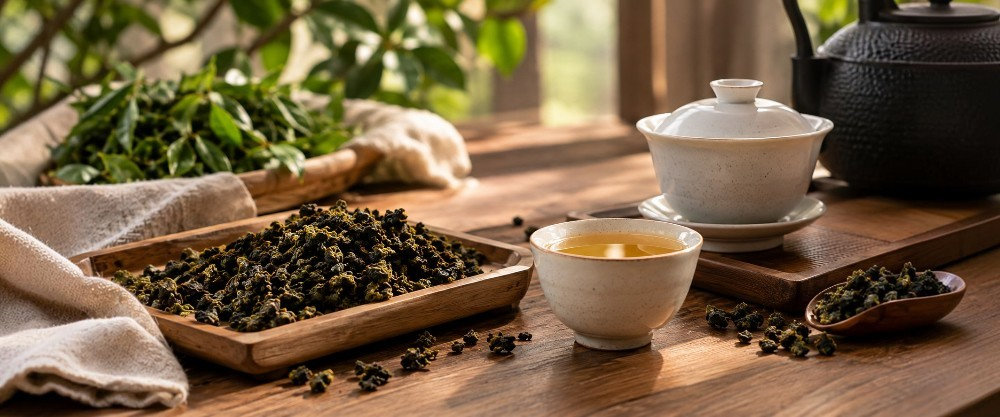
Most GABA oolongs have a naturally sweet, smooth flavor with notes of baked apple, apricot, raisins, honey, or caramel. Some examples also reveal subtle berry or citrus accents.
Another distinctive feature is the texture of the infusion. It often feels rounder and more velvety than a classic lightly oxidized oolong, while the finish remains long and pleasantly sweet without noticeable bitterness.
Taiwanese GABA oolongs are often brighter and fruitier, while Chinese GABA oolongs tend to show deeper caramelized and roasted notes.
How Does GABA Oolong Differ from Regular Oolong?
The main difference between GABA oolong and traditional oolong is the additional oxygen-free fermentation stage. Classic oolong oxidizes in open air, while GABA oolong undergoes anaerobic fermentation before the final drying process.
This changes not only the composition of the leaves but also the flavor profile. GABA oolongs usually taste sweeter, rounder, and fruitier, with softer astringency and a longer finish.
There is also a noticeable aromatic difference. Traditional light oolongs often feature orchid, lilac, or creamy floral aromas, while GABA oolong may remind you of baked fruit, honey, dried fruit, or delicate pastry notes.
Who Might Enjoy GABA Tea?
GABA tea appeals to many different tea drinkers, especially those who enjoy smooth, naturally sweet teas with very little astringency. If you like fruity or honey-like flavors, GABA oolong is an excellent place to start.
It is also popular among people moving away from flavored teas toward natural loose-leaf tea. Thanks to its natural sweetness, GABA tea feels rich and expressive without any added flavorings.
The TEAHOUSE collection includes several GABA oolongs with different roasting levels and aromatic profiles, making it easy to explore this category from lighter fruity styles to deeper caramel-and-honey expressions.
How Should You Brew GABA Tea?
GABA tea reveals its full potential through short, consecutive infusions. This brewing style allows the aroma and flavor to evolve gradually from cup to cup.
For most GABA oolongs, the ideal water temperature is 90-95°C (194-203°F). Water that is too cool will slow extraction, while oversteeping with boiling water can make the infusion overly intense.
Use about 5-6 grams of tea for a 150-180 ml gaiwan. Make the first infusion very short after rinsing the leaves, then gradually increase the brewing time with each subsequent infusion.
A simple TEAHOUSE tip: after the first infusion, smell the warmed tea leaves inside the gaiwan or teapot. This is where the fruit, berry, and honey aromas are often the most expressive.
What Should You Know Before Trying GABA Tea for the First Time?
The most important thing to remember is that GABA tea is not one single flavor. It is an entire category of tea shaped by origin, oxidation level, roasting style, and the producer’s approach to fermentation.
GABA tea is still a natural tea made from Camellia sinensis. Its uniqueness comes from the production process, which naturally changes the composition of the leaves and creates its recognizable flavor profile.
If you’re tasting GABA tea for the first time, a quality GABA oolong is the best introduction. It showcases the technology and the rich, layered experience that has made GABA tea so popular among Chinese tea lovers.
FAQ
What is GABA tea in simple terms?
GABA tea is a natural tea that undergoes a special anaerobic fermentation process, allowing the tea leaves to naturally develop a higher concentration of gamma-aminobutyric acid (GABA).
How is GABA tea different from regular tea?
The main difference is the production method. GABA tea goes through an additional oxygen-free fermentation stage that changes the composition of the leaves and influences its flavor profile.
Why is GABA tea usually an oolong?
Oolong teas respond especially well to anaerobic fermentation, developing the fruity, honey-like, and caramel notes that are typical of many GABA teas.
What does GABA oolong taste like?
GABA oolong is usually smooth and naturally sweet, with notes of baked fruit, honey, dried fruit, caramel, berries, and a velvety texture.
How should GABA tea be brewed?
For most GABA oolongs, use water at 90-95°C (194-203°F) and brew the tea using short, consecutive infusions. This method gradually reveals the tea’s full aromatic profile.
Чи була ця стаття корисною?
Ще немає оцінок — будьте першими.