Why Smell Dry Tea? Chahe as the First Stage of Tea Tasting
Today we will dive into a topic that often brings a slight smile or misunderstanding among beginners, but is absolutely fundamental for experienced connoisseurs. Let’s focus in more detail on the very beginning of our tasting, when we first meet a new tea variety. Experienced masters never rush to immediately pour water over the dry leaves, instead dedicating time to their visual and aromatic study. For this, a Chahe is used, which helps to comfortably examine the integrity of the raw material and gather all the volatile aromatic notes together. Such an unhurried approach allows you to properly tune into the process and get maximum pleasure from the upcoming tea drinking.
Inhaling the aroma of the dry leaf is a pragmatic and highly informative stage of tasting that allows you to tune into the process, predict the flavor profile of the future infusion, and even assess the quality of the raw material. Let’s figure out how this process works from both a scientific and aesthetic point of view.
Why Smell Dry Tea at All?
First of all, the sense of smell is our oldest and most powerful channel for receiving information. The aroma of the dry leaf can tell an attentive taster much more about the tea than the description on the label. It signals the freshness of the tea leaves, their storage conditions, and even the technological specifics of processing. A high-quality, properly stored tea will have a clean, distinct smell without foreign impurities of dampness, dust, or mold. Even a weak, barely perceptible aroma can be a sign that the tea is either too old or was exposed to unfavorable factors during transportation.
Apart from its purely informational function, inhaling the aroma acts as a kind of mental switch. When we bring the tea to our face and take a deep breath, we focus our attention, slow down the rhythm of our thoughts, and prepare our receptors to perceive the taste. This is the moment of transition from the mundane to a ritual, when the outside world retreats for a moment, leaving us alone with the richness of natural scents. Such preliminary tuning allows us to experience the taste more deeply when we finally take the first sip.
What is a Chahe and What Role Does It Play in Tasting?
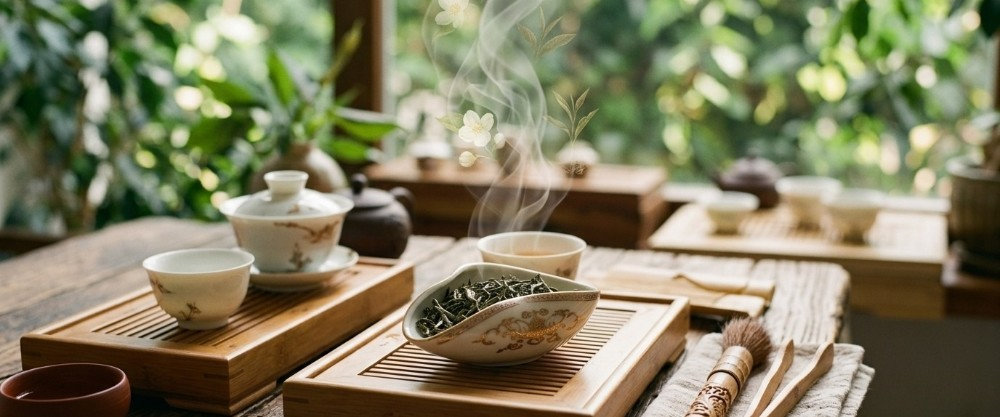
To make the introduction to the aroma as complete and aesthetic as possible, a special tool is used in the Chinese tea tradition—the Chahe. Literally translated, this means “tea lotus.” Usually, it is a small, elegant vessel, often made of porcelain, ceramics, or bamboo, shaped like a lotus petal or a cupped palm. Its purpose is twofold: the Chahe serves to present the dry leaf to guests and to facilitate the process of inhaling the aroma.
Why not just smell the tea from the bag or jar, you ask? The fact is that the shape of the Chahe is specially designed to concentrate volatile aromatic compounds. When you pour tea into the Chahe, its wide surface allows you to better examine the shape, color, and integrity of the leaf, which is also an important part of the tasting. But the real magic happens when you bring the Chahe to your nose: the curved walls act as a natural focus, directing the entire aromatic flow straight to your receptors, preventing it from dissipating into the space.
How to Properly Explore the Aroma of a Dry Leaf?
The very process of getting acquainted with the aroma in a Chahe has its delicate sequence. First, we simply bring the vessel to our face and take a calm, deep breath, evaluating the so-called “cold” aroma. Here we catch the lightest, most volatile notes—floral, grassy, fruity, depending on the type of tea. This is the first, most delicate impression.
Next comes a lifehack used by experienced masters to “awaken” the tea. Holding the Chahe with both hands, softly exhale warm air from your mouth directly onto the tea leaves. The warmth and moisture of your breath will instantly warm the raw material, activating the essential oils contained within the leaf. Immediately after this, take a deep, slow breath through your nose. You will be surprised by how much the aroma will change! The tea, “warmed” by the breath, reveals deeper, heavier notes—honey, nutty, caramel, woody—allowing you to form a more complete idea of its profile.
Our experts, who work daily with hundreds of tea leaf samples, confirm: this stage is critically important for the professional evaluation of lots. They note that it is in the Chahe, after a warm breath, that possible processing defects—or, conversely, unique, subtle nuances of the variety that will later become the basis of the infusion’s flavor profile—manifest themselves most clearly. Such meticulous selection guarantees that only the best will end up in your cup.
What Can the Smell of Dry Tea Tell You Before Brewing?
Each type of tea has its own unique aromatic code that we can try to decipher. For example, dry green tea often smells of freshly cut grass, young peas, a sea breeze, or light floral notes. White tea can have a delicate, barely noticeable scent of dried flowers, hay, or sweet wild herbs.
The characteristic profile of oolongs can be incredibly complex: light oolongs often impress with intense aromas of lilac, jasmine, orchid, or exotic fruits, while dark oolongs unfold with notes of baked bread, caramel, spices, and a light smokiness. Red tea (which we usually call black tea) often has warm, sweet aromas of dried fruits, honey, chocolate, or malt. Pu-erhs, on the other hand, can exhibit earthy, woody, nutty, or even camphor shades. Learning to recognize these basic profiles is a fascinating journey that begins right with the Chahe.
So the next time you are going to brew your favorite tea, do not rush to pour boiling water over it. Take a Chahe (or any clean, pre-warmed vessel), pour the tea leaves in, warm them with your breath, and inhale. Allow the aroma to tell you its story even before the first sip. This delicate attention to detail is the true beginning of tea magic.
Frequently Asked Questions
Is it necessary to use specifically a porcelain Chahe? No, it is not necessary, although porcelain retains heat well and does not absorb odors. You can use a Chahe made of ceramics, glass, or bamboo. The main thing is that the material is clean and does not have a strong smell of its own.
How many times should you inhale the aroma? Traditionally, the Chahe is passed around in a circle to the guests, and everyone inhales the aroma 2-3 times (cold, warm breath, inhale again). This is an individual process; the main thing is to manage to catch the changes in the aroma.
What to do if the dry tea doesn’t smell at all? This can be a sign that the tea is either too old or was stored in improper conditions and has “faded.” You can try to brew it, but you shouldn’t expect a rich flavor from such an infusion.